Just a few weeks ago, I finally finished my newest women’s fiction novel. I’m happy that this book is done. You can learn more about this Christmas women’s fiction sweet romance mystery here.
I’m excited this book is finally out in the world, because it took a little bit of time to write this newest book in the series.
You can see by the photo below a little bit of my process. I’ll explain more details on what I did to write and finish this novel below…
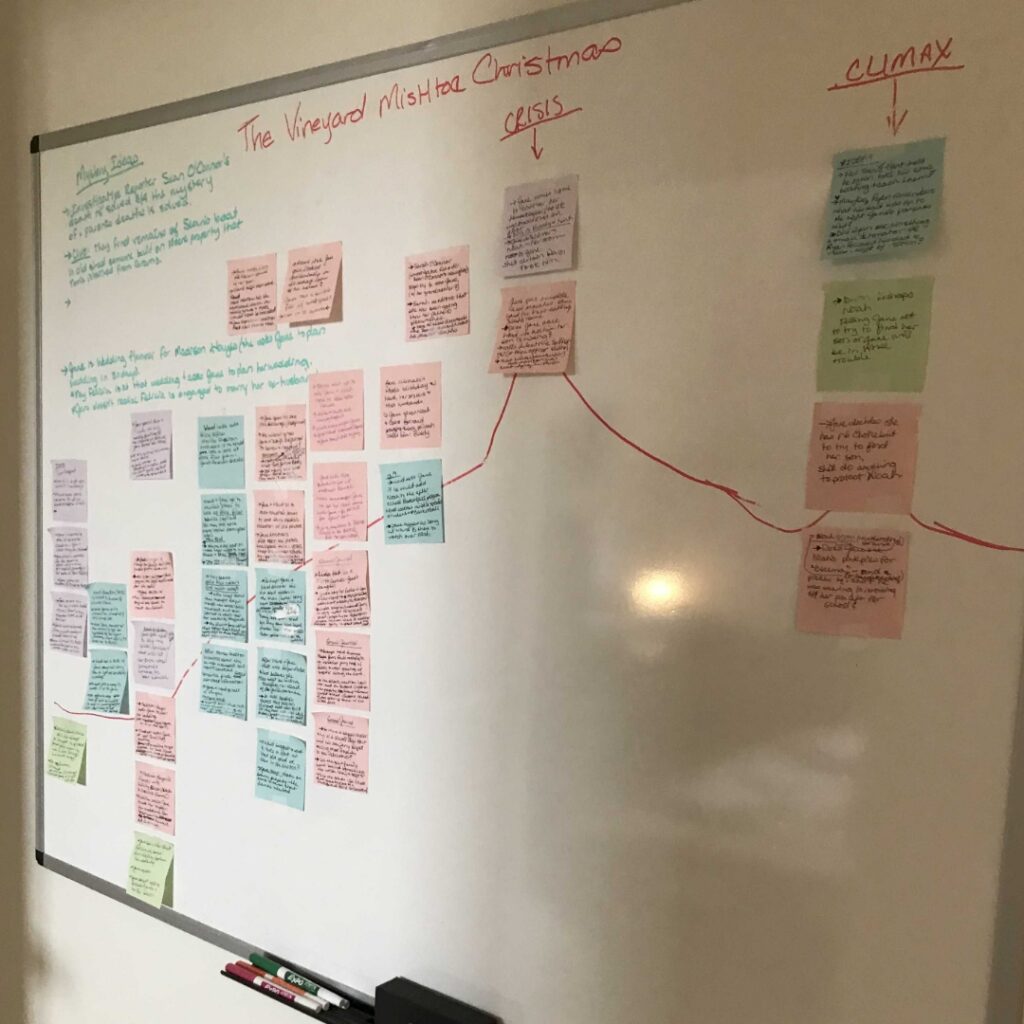
I used 2 Different Story Structures to Create a Rough Sketch for this Novel
You might be asking, what do you mean you used 2 different story structures? Wouldn’t it be easier to just stick with one?
I’ll explain.
This women’s fiction mystery series, is a little different than the other novels I’ve written.
With each novel in this series, I’ve needed to figure out and brainstorm 2 unique mysteries.
First, I’ve needed to brainstorm the details of the mystery that are contained in that particular novel.
It’s a sweet and clean romance, so there’s nothing graphic or violent. But I still need to figure out what that mystery will be and what the final climactic scene will be.
Second, I needed to brainstorm what will be the mystery in each book that will tie-into the overarching mystery for this women’s fiction series.
That can be where it gets complicated. You see I started this series, with a plan to write seven books in this series. Yes, SEVEN! I don’t know what I was thinking, but there it is… lol;).
Since there are seven books — four are still in the planning stages as of this writing — my idea was that for each book there would be a mystery revealed which would culminate in the Big Mystery Reveal, in the last novel(book #7).
In the final book, readers will finally learn who stole the pink diamond and the reason behind the deaths of important people on the island, and the people that were responsible.
This is where I needed to figure out how to plan my novel in such a way so it made sense… at least so it made sense to me.
I used the 2 different Story Structures below:
- James Scott Bell’s simple story structure from his book, Plotman to the Rescue.
In James’ book, he tells of a metaphor from E.L. Doctorow. The quote below is something I do all the time and reveals the way I write novels. He says…
“Writing a novel is like driving at night with the headlights on. You can only see the road ahead as far as the headlights allow. When you drive to that spot, you can see a little further.” ~E.L. Doctorow
This story structure, is quite simple to understand. Which is exactly what I need when I write novels, because the truth is, I am mostly a pantser.
Since I’m not really someone who likes to outline a novel, I needed a way to quickly sketch out a draft of my ideas.
Below is the first simple story structure I used from James Scott Bell’s book, Plotman to the Rescue.
1.Opening Disturbance: Any change or trouble in the Lead character’s ordinary world.
2.Care Package: Write about the Lead Character showing compassion for someone they care about early on in the story.
3.Argument Opposed to Transformation: This is a moment where the Lead Character states a belief that will be overturned in the end. In other words, what the Lead Character states in the beginning, will be shown to be a misbelief or lie by the end of the novel.
4.Trouble Brewing: Things settle for a little bit after the disturbance, but then the Lead Character gets a glimpse of more trouble coming.
5.Doorway of No Return #1: This is where the Lead Character is thrust into confrontations of Act II.
6.Kick in the Shins: As the Lead Character tries to solve the problem and reach his/her goal, the Lead suffers a big setback.
7.The Mirror Moment: James Scott Bell describes this: In the very middle of a good book or movie you will often find a moment when the lead character is taking a look at himself or herself, as if in a mirror. a)In one type, the character is forced to look at his life and confront his moral failings. b)The second type, is when the character looks at herself and her situation and understands the odds against victory are too great, that death — physical, professional, psychological, is imminent.
8.Pet the Dog: As the Lead gets into trouble in Act II, he or she takes time out to help someone or an animal weaker than themselves, even at the cost of more trouble.
9.Doorway of No Return #2: This is a major crisis, setback, clue or discovery. This makes the final climax/battle necessary.
10.Mounting Forces: The antagonist, who knows the battle is on and that the Lead character is committed to his/her goal — brings in more forces.
11.Lights Out: This is the darkest part — or the dark night of the soul where it seems all is lost — for the Lead Character.
12.Q Factor: This is an emotional push that gives the Lead Character the courage to fight and to make the right choice by remembering something/someone of emotional impact.
13.Final Battle: The Lead Character faces Outer and Inner forces.
14.Transformation: Normally, this is the last chapter of your book and it’s where the readers will see the Lead Character has changed(even if only a little), to a stronger and better version of themselves.
Simple, right?
The way I used the above plot points, is I sketch out one-liners(a simple sentence) for possibilities for each point in the plot structure.
But sometimes, I don’t even finish that before I dive into writing the novel.
However, one detail I feel I must have before I start writing any novel is this: I must know what the Main Character’s greatest fear is, that they’ll be forced to face at the climax. Which usually means, I also need to have a deeper understanding of both the Main Character’s goals/motivation as well as the Antagonist’s goals/motivation.
If you have a good understanding of your main character’s greatest fear, this also gives you a glimpse into the beginning of your novel.
Why? Because then you’ll also understand the Lies and Misbeliefs your Main Character tell themselves at the start of the story. This misbeliefs in your Main Character will be transformed into the truth by the end of the novel.
Below is the second story structure I used. This from Martha Alderson’s book, The Plot Whisperer.
2. I used Martha Alderson’s Story Structure from her book, The Plot Whisperer.
There are a few big points that she follows in her story structure. And it’s helpful that it’s written out in a line graph that begins at the bottom and the line leads up to the climax of the novel. I find visual pictures of where my novel is headed very helpful.
1.The Beginning: The first quarter of your story, you hook readers with present moment-to-moment conflict. Your Main Character faces dilemma, a loss, feels fear and is motivated to action.
Martha suggests writers keep the backstory vague in the beginning of your novel, so that your reader can actively participate in the story by filling in the blanks.
2.End of the Beginning: Something happens to make the Main Character’s old world no longer fit. They break from the old world and the character embarks on a journey into a new world / adventure.
3.The Middle–Resistance and Struggle: As the main character enters the middle of the story, she is confronted with a strange world. The new world seems dark and deals with good and evil.
4.Halfway Point: This is the next major turning point. Characters might want to give up, or they might set a new resolve to reach their goal.
5.The Crisis: Often this where the Main Character suffers loss, fear, failure and despair. The conflict or suspense continues to rise until the breaking point.
6.Transformation and Return: After the crisis the Main Character finds a way forward — often he/she has an aha moment and finally knows what to do. The transformation begins when the Main Character takes those last steps necessary to reach their long-term goal.
7. Climax: This is where your Main Character shows the reader his/her transformation– into the person the story intended them to become all along.
8. Resolution: This is a look at your Main Character now that she/he has transformed.
Having a deeper understanding of your main character is the secret to writing a great story.
Stories that cause readers to stay up late turning page after page, are those where the characters are emotionally affected by the events in the story — and they are transformed.
The story structures above, are simply guides to help lead you to your amazing ending.
So go ahead and start writing a rough sketch of your story. It doesn’t need to be detailed. Simply, write down your ideas.
You can do this! 🙂